What Should Suppliers Know About UNHCR Procurement for Core Relief Items?
What Should Suppliers Know About UNHCR Procurement for Core Relief Items?
I often see suppliers lose chances because they only look at price. The real pain starts when quality, audits, documents, and delivery are not ready.
I believe suppliers should understand the full UNHCR core relief item system, not only one product. I should prepare stable quality, compliant materials, clear test reports, social audits, and sustainable options. This makes procurement easier for UNHCR and also makes cooperation safer for suppliers.
When I work on emergency water containers and relief products, I always remind myself of one simple thing. Humanitarian procurement is not normal trading.1 The product must arrive fast.2 The product must work in hard places. The product must be safe for families who may have lost everything. So I cannot treat UNHCR procurement as only a quotation job. I need to treat it as a long-term supply system.
What Core Relief Items Does UNHCR Usually Need?
I have seen many new suppliers focus on only one item, then miss the bigger picture. This creates confusion when buyers ask for a full relief package.
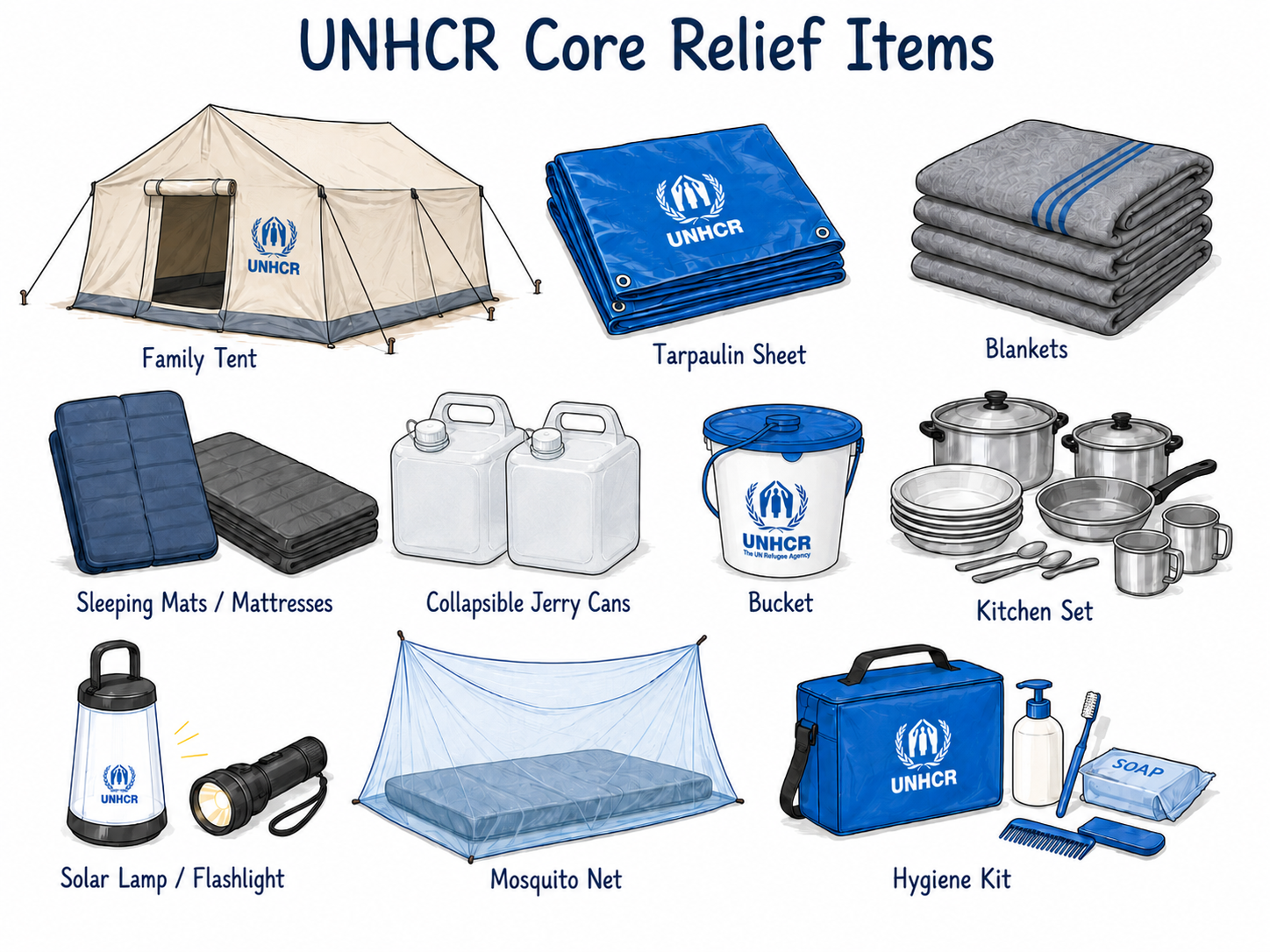
UNHCR core relief items usually include family tents, plastic tarpaulins, blankets, sleeping mats, kitchen sets, jerry cans, buckets, mosquito nets, solar lamps, hygiene-related items, and other basic household products for displaced families.3
I usually group these products by the basic needs of a family. This helps me understand why each item matters. A folding water container is not just a plastic product. It is part of safe drinking water storage.4 A blanket is not just fabric. It is warmth at night. A kitchen set is not just cookware. It helps a family cook again.
| Need | Common Core Relief Items | What I Check as a Supplier |
|---|---|---|
| Shelter | Family tents, tarpaulins, ropes | Strength, packing size, weather resistance |
| Water | Jerry cans, buckets, collapsible water containers | Food contact safety, leakage, drop test |
| Sleep | Blankets, sleeping mats | Material, size, warmth, durability |
| Cooking | Kitchen sets | Metal safety, packing, usability |
| Health | Mosquito nets, hygiene items | Safety, test reports, clear labeling |
| Light | Solar lamps | Battery safety, working time, charging |
I pay close attention to water items because this is my main product area. For collapsible water containers, I focus on food-grade material, BPA-free options, tight caps, strong handles, and stable folding performance.
How Should I Prepare for UNHCR-Style Procurement?
I know many suppliers want to sell to UNHCR, ICRC, IFRC, UNICEF, IOM, MSF, and NGO buyers. But I also know that a simple factory profile is not enough.
I should prepare product specifications, test reports, factory audit documents, social responsibility records, packing details, and production capacity data before I contact humanitarian buyers.5 A supplier who is ready saves time for both sides.
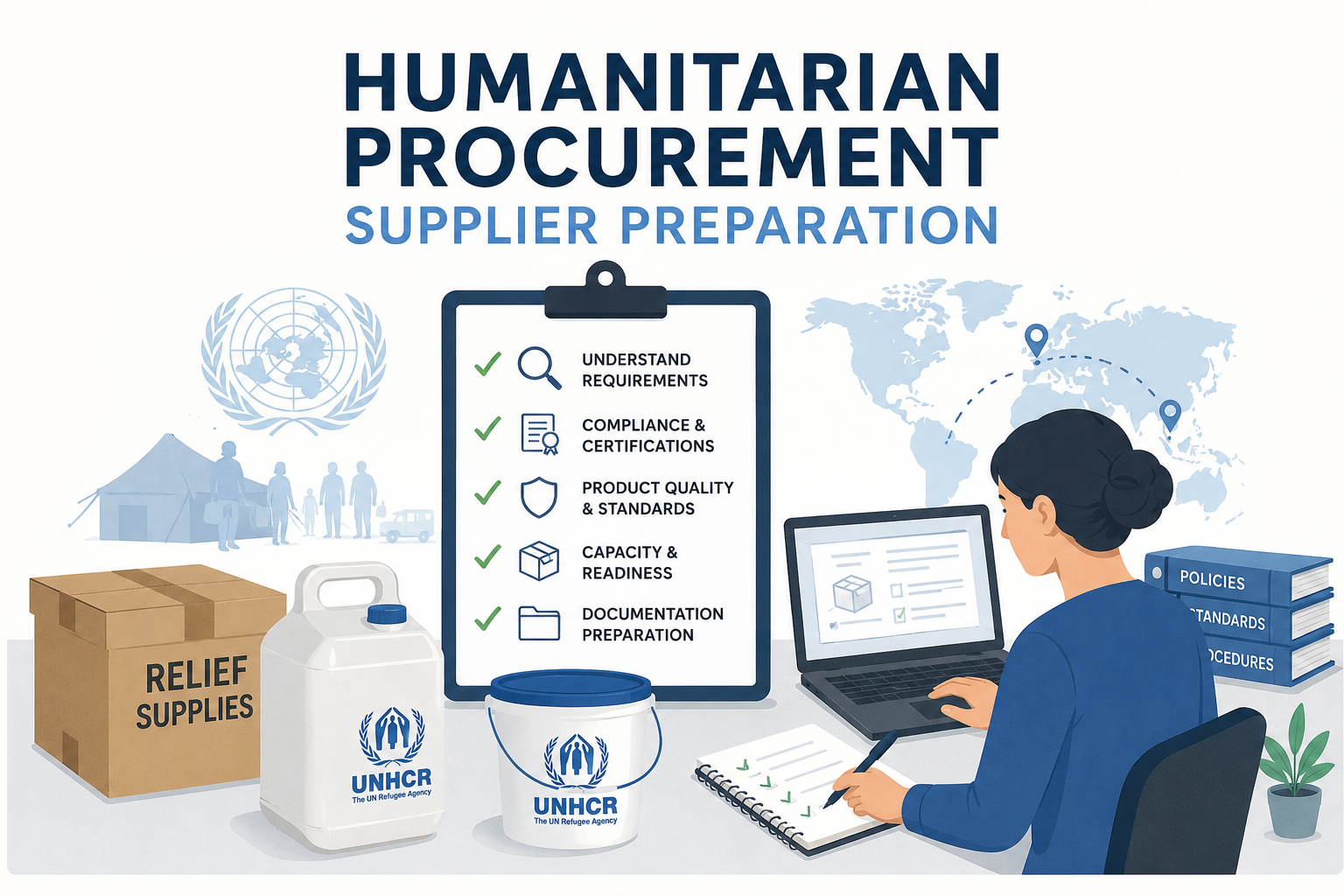
I look at procurement from the buyer’s side first. A humanitarian buyer needs low risk. The buyer wants products that match standards.6 The buyer wants factories that can pass audits. The buyer wants stable delivery in urgent situations. So I should make my factory easy to evaluate.
| Area | What I Prepare | Why It Matters |
|---|---|---|
| Product quality | Drawings, size, weight, material, samples | Buyers need clear comparison |
| Safety | FDA, LFGB, EU, GB, BPA Free reports when needed | Water and food contact items need trust7 |
| Factory system | ISO 9001, ISO 14001, ISO 450018 | Buyers check management ability |
| Social audit | WCA, SEDEX, labor records | Humanitarian buyers care about responsible sourcing9 |
| Performance | Drop test, leakage test, temperature test | Relief items must survive real use |
| Packing | Inner bag, carton, pallet, shipping marks | Bulk delivery needs clean control |
I also think suppliers should be honest about capacity. If I can produce 20,000 pieces fast, I should say 20,000. I should not promise 100,000 if I cannot support it. In relief procurement, a broken promise can delay help to real people.
Why Will Standardization Help Both Organizations and Suppliers?
I believe the next direction is more shared standards between large humanitarian buyers. Without shared rules, suppliers repeat the same work again and again.
If UNHCR, ICRC, IFRC, UNICEF, IOM, and MSF move toward unified product standards and unified factory audits, procurement can become faster, clearer, and more friendly to qualified suppliers.
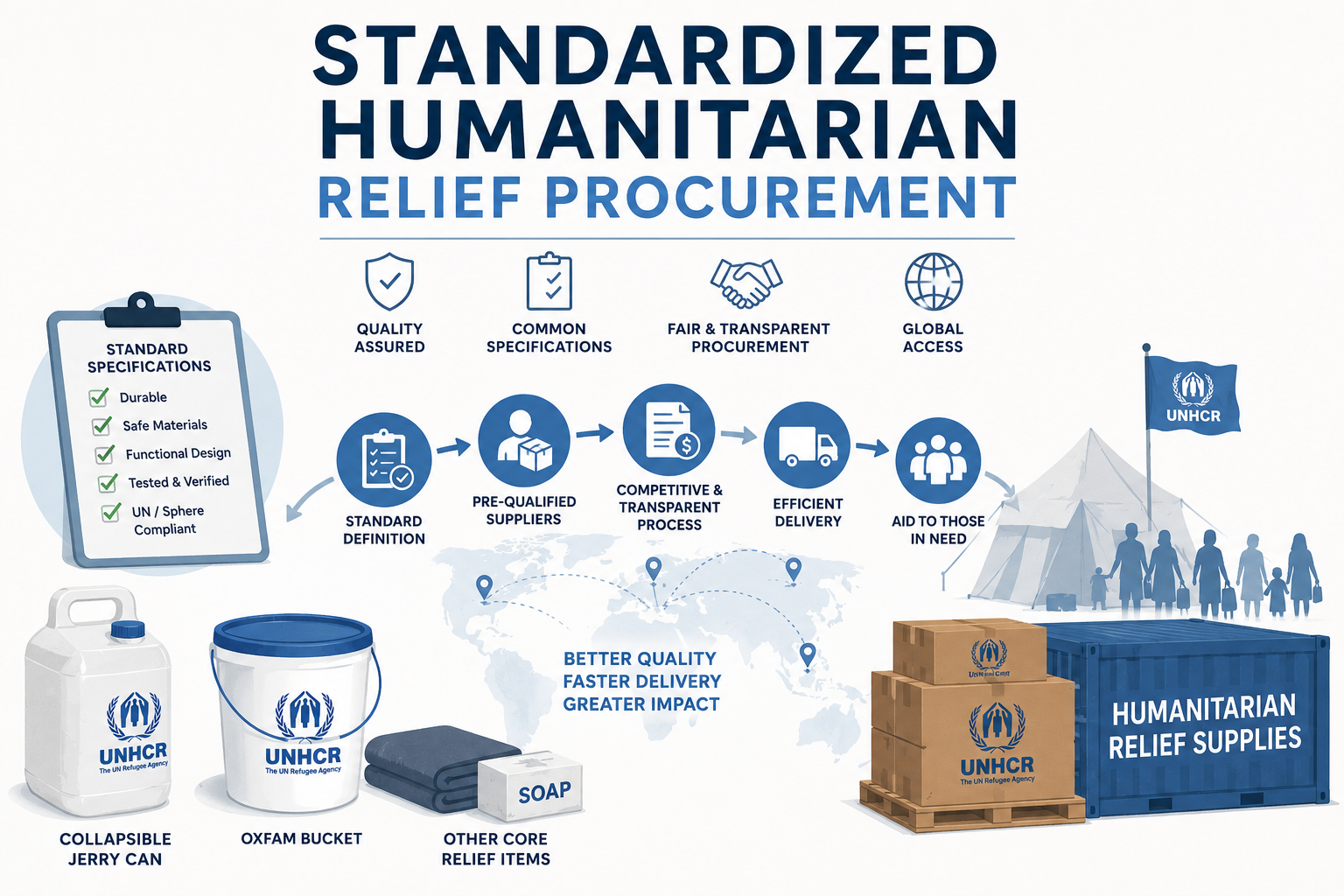
I think this kind of alliance approach is useful. Each organization has its own needs, but many core relief items are similar. A water container for UNHCR and a water container for IFRC may have similar safety needs. A factory audit for UNICEF and IOM may check many of the same points. So one shared standard can reduce repeated testing, repeated audits, and repeated paperwork.
| Current Problem | Unified Approach | Benefit |
|---|---|---|
| Different product specs | Common product standards | Easier supplier preparation |
| Repeated factory audits | Shared audit recognition | Lower cost and less time |
| Different test requests | Common test framework | Faster approval |
| Separate supplier files | Shared supplier database | Better buyer visibility |
| Unclear packaging rules | Standard packing guide | Smoother logistics |
As a supplier, I would welcome this direction. I can invest more in real product improvement instead of doing the same documents many times. I can also plan molds, materials, inventory, and packing with more confidence. For emergency products, this matters because speed is part of quality.
How Can I Add Sustainability to Core Relief Items?
I do not think sustainability should be only a slogan. I think it should become part of product design, material choice, packing, and delivery planning.
Suppliers can support sustainable procurement by using renewable or recycled materials when suitable, reducing packaging waste, improving product life, lowering transport volume, and giving clear material data to buyers.
For collapsible water containers, sustainability starts with space saving. A folded product can reduce storage volume and transport cost. This means one container or one warehouse can hold more units. I also study materials with recycled content or renewable sources, but I must balance this with food contact safety. If a product stores drinking water, safety must come first.
| Sustainability Action | My Practical View |
|---|---|
| Use renewable raw materials | I can test bio-based materials when safety allows |
| Use recycled content | I can consider it for non-food-contact parts first |
| Reduce carton waste | I can design stronger and simpler export cartons |
| Improve product life | I can use stronger seams, caps, and handles |
| Save transport space | I can use foldable designs for high-volume projects |
| Share material data | I can give buyers clear compliance records |
I believe sustainable relief products must still be strong, safe, and affordable. If a green material fails in the field, it is not a real solution. So I prefer steady improvement. I would start with better design, less waste, longer service life, and safer material options.
Conclusion
I see UNHCR procurement as a system. I should prepare quality, audits, standards, sustainability, and delivery before I expect real opportunities.
"Humanitarian Procurement Efficiency IAPG's Requests to Donors", https://reliefweb.int/report/world/humanitarian-procurement-efficiency-iapgs-requests-donors-institutional-donors-requirements-non-alignment-humanitarian-procurement-june-2025. Studies of humanitarian supply chains describe emergency procurement as operating under high uncertainty, compressed lead times, accountability requirements, and beneficiary-focused objectives, distinguishing it from routine commercial trading. Evidence role: expert_consensus; source type: paper. Supports: A peer-reviewed source should explain how humanitarian procurement and logistics differ from commercial supply chains because of urgency, uncertainty, donor accountability, and humanitarian objectives.. Scope note: This supports the general distinction between humanitarian and commercial procurement, not the author's specific supplier experience. ↩
"Delivering supplies - UNHCR", https://www.unhcr.org/what-we-do/respond-emergencies/delivering-supplies. Humanitarian logistics guidance from major relief organizations treats timely delivery of relief supplies as a central objective in emergency response, because delays can affect the availability of essential assistance. Evidence role: general_support; source type: institution. Supports: An institutional logistics or emergency response source should show that rapid delivery is central to emergency relief operations.. Scope note: This supports the general importance of speed in emergency relief, not a specific UNHCR delivery threshold for every item. ↩
"[PDF] Core Relief Items Label Catalogue - UNHCR", https://www.unhcr.org/sites/default/files/2023-07/cri_label_catalogue.pdf. UNHCR core relief item catalogues and emergency guidance identify shelter materials, blankets, sleeping mats, kitchen sets, water containers, buckets, mosquito nets, lamps, and hygiene-related household items as standard assistance goods for displaced populations. Evidence role: definition; source type: institution. Supports: An official UNHCR source should confirm the types of items included in UNHCR core relief item catalogues or emergency household assistance.. ↩
"Household Water Treatment and Safe Storage (HWTS) in ... - UNICEF", https://www.unicef.org/innovation/household-water-treatment-and-safe-storage-hwts-emergency-settings. WHO and WASH guidance describe safe household water storage as requiring clean, covered containers that limit recontamination of drinking water after collection or treatment. Evidence role: mechanism; source type: institution. Supports: A WASH source should explain that suitable household water containers support safe drinking-water storage by reducing contamination after collection or treatment.. Scope note: This supports the role of appropriate water containers in safe storage, not the safety of any particular collapsible container model. ↩
"[DOC] https://www.ungm.org/Shared/KnowledgeCenter/Docume...", https://www.ungm.org/Shared/KnowledgeCenter/Document?widgetId=3432&documentId=899024. UN procurement and supplier-registration guidance commonly requires suppliers to provide legal, technical, quality, compliance, and capacity information so that buyers can evaluate eligibility and performance risk. Evidence role: general_support; source type: institution. Supports: A UN procurement or supplier registration source should support that suppliers are assessed through technical specifications, quality documentation, compliance information, and capacity evidence.. Scope note: This supports the documentation categories generally; exact document requirements vary by solicitation and organization. ↩
"Bidding opportunities - UNHCR", https://www.unhcr.org/us/get-involved/work-us/become-supplier/bidding-opportunities. UN procurement guidance treats compliance with technical specifications and solicitation requirements as a central part of evaluating offers for goods. Evidence role: general_support; source type: institution. Supports: A procurement manual should confirm that goods are assessed against technical specifications and solicitation requirements.. Scope note: This supports the general evaluation principle; it does not identify the specific standards for each core relief item. ↩
"Food contact materials in the EU: State of play - Epthinktank", https://epthinktank.eu/2026/03/03/food-contact-materials-in-the-eu-state-of-play/. Food-contact material regulations require materials and articles intended to contact food to be safe for their intended use, reflecting the risk that chemical constituents may migrate into food or drinking water. Evidence role: mechanism; source type: government. Supports: A food-contact regulatory source should explain that materials in contact with food or drinking water are regulated because substances can migrate and affect safety.. Scope note: This supports the need for compliance evidence for food-contact items; it does not validate any specific FDA, LFGB, EU, GB, or BPA-free certificate. ↩
"Standards - ISO", https://www.iso.org/standards.html. The International Organization for Standardization identifies ISO 9001, ISO 14001, and ISO 45001 as management-system standards for quality, environmental management, and occupational health and safety, respectively. Evidence role: definition; source type: institution. Supports: An ISO source should define ISO 9001 as a quality management standard, ISO 14001 as an environmental management standard, and ISO 45001 as an occupational health and safety management standard.. Scope note: This defines the standards; it does not prove that every humanitarian buyer requires certification to them. ↩
"[PDF] UN SUPPLIER CODE OF CONDUCT - UNHCR", https://www.unhcr.org/lb/sites/lb/files/legacy-pdf/Annex-F_UN-Supplier-Code-of-Conduct.pdf. UN supplier conduct frameworks require vendors to observe standards on labor, human rights, ethics, and environmental responsibility, showing that responsible sourcing is part of supplier management. Evidence role: expert_consensus; source type: institution. Supports: A UN or humanitarian supplier code should show that suppliers are expected to comply with labor, human rights, ethics, and environmental standards.. Scope note: This supports responsible sourcing as a policy expectation; individual audit methods differ among organizations and contracts. ↩